
The Mind Killer
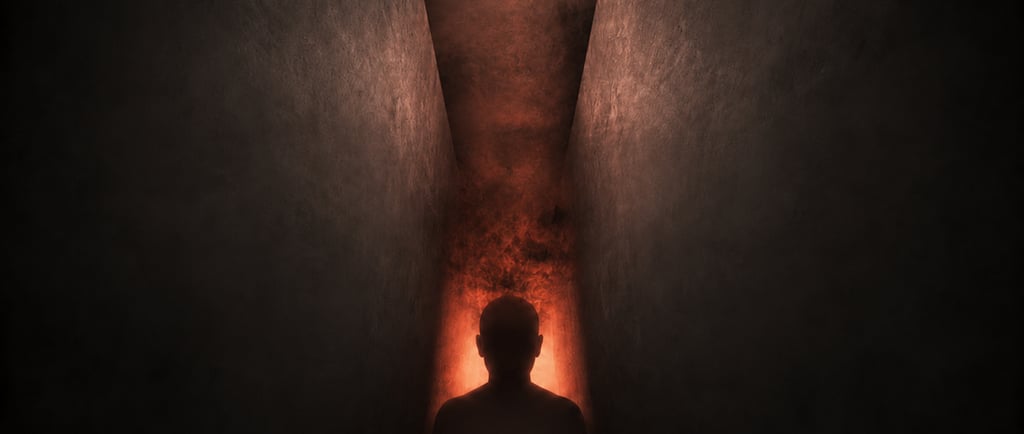
True transformation often reveals itself first as a visceral contraction, a sudden narrowing of the world that occurs the moment the familiar begins to dissolve. Whether we choose the leap or find ourselves cast into the void, the underlying threat is the "little-death," a psychological paralysis that trades our creative agency for the hollow work of managing apprehension. Reclaiming the path forward requires moving through this inner gatekeeper, shifting from a state of mere survival toward the expansive presence that waits on the other side of the phantom future. #InnerAlignment #PsychologicalResilience #NavigatingChange #TheHumanCondition #PresenceOverFear #IntentionalLiving
COURAGEACTIONMINDSET
May 11, 2026
The Mind Killer
“Fear is the mind-killer. Fear is the little-death that brings total obliteration.”
- Frank Herbert
We have all felt that sudden, cold contraction in our chest, that sharp, visceral stab of terror. It arrives the moment the status quo is threatened, regardless of whether we are the ones holding the match or if the fire was started by someone else.
Sometimes, it strikes when we actively choose change: switching a job, establishing a difficult boundary, ending a relationship, or finally starting the project that we’ve whispered about for years. Other times, it hits when change is thrust upon us, arriving unbidden as a sudden layoff, an unexpected goodbye, or a shift in circumstances that we never asked for.
In any case, the effect is the same. Our world instantly shrinks. The expansive possibilities of a moment ago are crushed by a singular, looming question: What if I can’t handle what comes next? Whether it’s we who choose to jump into the situation or we are pushed into it, fear is the gatekeeper that lies on the path before us.
This is the "little-death" that Frank Herbert wrote about in his transformational book Dune. It isn't usually a physical ending, but a psychological one. It is the moment we allow a phantom future to dictate our present reality. When fear takes the wheel, our creativity, our logic, and our authentic selves are pushed into the backseat. We stop living, and we start merely "managing" our anxiety.
The Phantom
Fear doesn’t always arrive with a roar. More often, it arrives as a whisper of "not yet" or "maybe later." It kills the mind by narrowing our vision. Think of it like a thick coastal fog rolling in over a beautiful landscape. The mountains, the ocean, and the path ahead are all still there, but because you can no longer see them, you stop moving. You stand still, paralyzed by the phantom of what might be hiding in the grey.
The "obliteration" Herbert mentions is the loss of your perspective. When you are afraid, you lose the ability to see the resources that you have, the strength that you’ve built, and the beauty of the journey itself. You aren't being destroyed by the world, you are being dimmed by your own apprehension.
Reflection
On a personal note, Dune was transformational for me. I was fifteen when I first stepped into Arrakis, and the novel did more than just provide a vivid new world to explore. It blew the doors off my intellectual horizon.
Suddenly, I was grappling with disciplines that I hadn't even contemplated before: philosophy and sociology, the intricate gears of politics and religion, the balance of ecology, psychology and the limits of human potential. It was an awakening for me.
To do justice to the weight of that influence on my life, I want to share the Litany Against Fear in its entirety. It remains one of the most powerful meditations on resilience ever written:
"I must not fear. Fear is the mind-killer. Fear is the little-death that brings total obliteration. I will face my fear. I will permit it to pass over me and through me. And when it has gone past I will turn the inner eye to see its path. Where the fear has gone there will be nothing. Only I will remain."
Moving Through
The secret to personal growth isn't the absence of fear. The absence of fear is a myth that is sold by people who aren't in the arena. The secret is the refusal to let fear control you and be the final word. To "allow it to pass over you and through you" is to acknowledge the feeling without giving it the keys to your life.
When we face the fog of fear, when we push past the terror and step through anyway, we realize something profound: that the phantom of fear doesn't actually have any true substance. It can’t really stop us. It can only try to convince us to stop ourselves.
5 Steps
To keep your momentum this week and prevent the "mind-killer" from taking hold, try these five practical steps:
Name the "Little-Death": Identify one thing that you are currently avoiding. Is it a difficult conversation? A creative risk? Simply naming it - "I am avoiding X because I am afraid of Y" - strips the fear of its mystery and returns it to the realm of logic.
Audit Your Information Intake: Fear is often fed by external noise. This week, notice which voices (social media, news, or even certain friends) leave you feeling contracted and small. Limit those inputs to create space for your own clarity.
Practice The Breath: Before reacting to a stressor, use a centering breath to "permit the fear to pass through you." Inhale deeply for four seconds, hold for four, and exhale slowly (through pursed lips) for eight. This extended exhale signals your nervous system to move from "fight-or-flight" back into a state of calm, analytical command.
The “Five-Minute Foray”: When fear makes a task feel as large as a mountain, commit to just five minutes of action. Choose one small step you can take right now. It should be something simple enough to begin, but meaningful enough to create momentum. Fear feeds on the overwhelming size of the “big picture,” but it loses strength when you focus on narrow, immediate, and manageable next step.
Ground the Physical Body: Fear lives in the future, but your body lives in the now. When you feel that mental "obliteration" starting, use a simple grounding technique: find three things you can touch and two things you can smell. Bringing yourself back to the present moment dissolves the phantom threats of "what if."
As you head into this week, remember that you are far more resilient than the feelings that try to hold you back. Fear may visit you, but you don’t need to let it stay. Let it pass through you, notice what it is trying to tell you, and then gently return to the work of becoming who you were meant to be. You are still here. Your path is still before you. And you have the power to dispel the phantom of fear.
Master Storyteller
Frank Herbert (1920–1986) was a prolific American sci-fi author best known for his epic masterpiece, Dune. Beyond his world-building, Herbert was a deep thinker interested in philosophy, ecology, and the untapped potential of the human psyche. His work frequently explored how humans can transcend their primal instincts to achieve higher states of consciousness and resilience, a theme that remains a cornerstone for anyone seeking to master their own inner world and overcome the paralysis of fear.
Reflect
Empowering you to live your authentic life.
Journey
asaunlimitedsoul@gmail.com
© 2024. All rights reserved.