
The Shape of Hope
Disappointment rarely arrives all at once; it often creeps in through a succession of closed doors and unseen losses until the horizon feels impossibly distant. Beneath the surface of our functioning lives, these silent accumulations can leave us profoundly weary, treading water against a rising tide of doubt. In these heavy spaces, the most vital work we do is the quiet defense of a single conviction: guarding the fragile belief that change remains possible. Protecting this ember of hope becomes an act of quiet defiance, anchoring us to the truth that our deepest current pain is merely a passage, not the conclusion of the story. #EmotionalEndurance #QuietStrength #NavigatingLoss #TheWorkOfHealing #SustainingHope #InnerLandscape #Resilience
PERSEVERANCE & RESILIENCEMINDSET
May 25, 2026
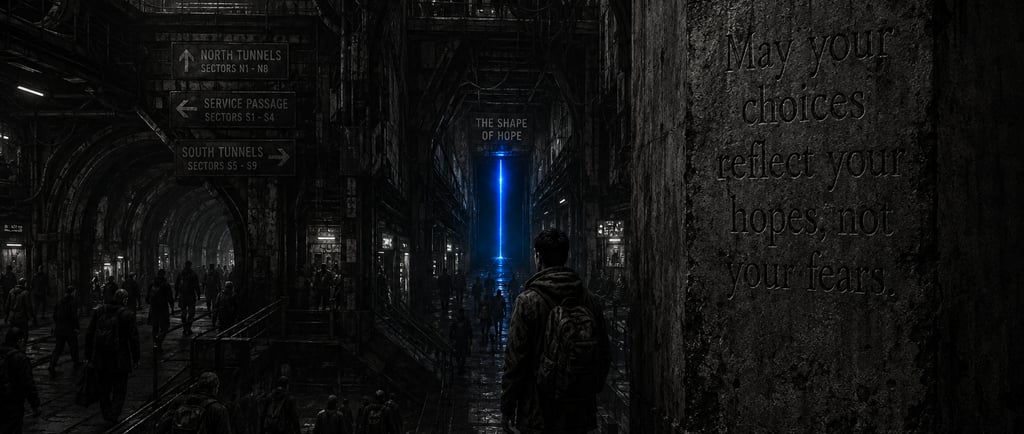
The Shape of Hope
“May your choices reflect your hopes, not your fears.”
- Nelson Mandela
There are periods in our life when fear, doubt, and disbelief get loud in our head. They can drown our happiness and drag us down with despair. But they can also simply diminish our hope slowly over time.
A disappointment here. A loss there. A door that closes. A prayer that feels unanswered. A private battle no one else can see. And little by little, you can’t see any positive future.
Those are the moments when despair can feel like water rising around us. We may still be functioning on the outside, still answering messages, still showing up, still doing what needs to be done. But inside, something feels tired. And you wonder how much longer you can keep swimming.
The battle is sometimes about protecting the small remaining part of us that believes life can change. That healing is possible. That help can come. That this moment, as painful as it is, is not the end of the story.
Invisible Power
Chamath Palihapitiya has shared a memorable version of an old experiment about hope. In the popular retelling, mice were placed in water and, without any expectation of rescue, gave up quickly and began to drown in about 4 minutes. But when they were pulled out just before that, held, and given the experience of being saved, something changed. When they were placed back in the water, they endured far longer – about 60 hours! Not because the water became easier. Not because they became stronger overnight. But because they now carried a memory that said, this may not be the end.
(For your reference, the original study was detailed in a 1957 paper by Curtis R. Richter titled, "On the Phenomenon of Sudden Death in Animals and Men." In it, he demonstrated that rats which normally gave up within minutes could suddenly swim for 40 to 60 hours after being briefly rescued, proving that a sense of hope can unlock extraordinary physical endurance.)
This story/experiment is hard to believe because of the contrast: 4 minutes vs 60 hours. Within this story is such a powerful lesson for us all. The lesson is not that hope magically removes suffering. It does not. Hope does not take away the water. It does not erase exhaustion. It does not guarantee the outcome. But it does change what we believe is possible while we are in the process of struggle.
And sometimes, that belief is the difference between giving up too soon and finding our way through.
Close to Home
The reason I am writing about this now is because a dear friend of mine, one of my very best friends, recently died by suicide.
He was hopeless. And he simply could not see a way forward.
And that is one of the most heartbreaking things about hopelessness. From the outside, other people may see options. They may see love. They may see tomorrow. They may see a hundred doors that still exist.
But when someone is deep inside that kind of darkness, the mind can start to believe there are no doors at all.
There are losses that do not fit neatly into words. You replay conversations. You wonder what you missed. You wish you could have offered one more moment of comfort, one more reminder, one more hand reaching through the dark saying, please stay; this is not the end of your story.
I do not share this as a lesson wrapped in grief. I share it as a sacred reminder.
Hopelessness is not weakness. It is not a character flaw. It is not something people simply “snap out of.” It is a narrowing of the future until pain becomes the only thing a person can see.
That is why hope matters so much.
Not fake optimism. Not empty positivity. Not pretending life is easy when it is clearly not.
But real hope. The kind that sits beside someone and says, I know this is heavy. I know you are tired. But I am here. Let us just make it through this next moment.
Sometimes the greatest gift we can give another human being is not advice. It is presence. It is patience. It is the steady reminder that they are not alone.
Choices
Every day, in small ways, you choose from one of two places.
Fear asks: What if I fail? What if they reject me? What if I am not ready? What if it hurts again? What is the point?
Hope asks: What if I grow? What if this opens a door? What if I can handle more than I think? What if I am allowed to begin again? What if it changes my life?
Most of the time, embracing hope does not look dramatic. It looks like taking small daily actions that support a better tomorrow. It’s making the call. Telling the truth. Going to therapy. Starting the project. Applying again. Taking care of your body. Getting out of the house. Asking for help before you are drowning.
Fear wants you to confuse safety with stillness.
Hope reminds you that you need to act for it to work.
The Lantern
Hope is not a blazing sun that erases every shadow.
Most of the time, hope is smaller than that.
It is a lantern in your hand on a dark road.
It does not show you the whole path. It does not explain every turn. It does not promise that the road will be easy. It simply gives you enough light for the very next step.
And sometimes that is all you need.
One step toward the conversation.
One step toward healing.
One step toward discipline.
One step toward asking for help.
One step toward the person that you said you wanted to become.
Fear doesn't have to stop you. Even a small step forward is sometimes enough to break the spell of feeling trapped. Focus on breaking the inertia of the cycle that you are in.
Action Plan
This week, choose hope in practical ways.
Name the fear without obeying it: Think of one decision that you have been avoiding. Then ask yourself: What am I afraid will happen? What is the emotion that you are feeling? Fear loses some of its power when you stop letting it operate in the shadows. You don’t have to shame it. And you don’t have to pretend it is not there. Just clearly name it. There is power in naming it.
Take one hope-based action:
Do one thing this week that reflects the future that you want.
Send the message. Take the walk. Start the outline. Make the appointment. Clean the room. Repair the relationship. Open the document. Make the plan.
It does not have to be extensive or complete. It just has to be something you genuinely want. Small actions are how hope becomes real.
Create a rescue point
Identify one person, place, or practice that helps you remember that you are not alone.
Maybe it is a friend you can call. Maybe it is prayer. Maybe it is therapy. Maybe it is a walk near the ocean. Maybe it is journaling at night when your thoughts are too loud.
Do not wait until you are drowning to decide what your rescue point is. Build it now.
Speak to yourself like someone worth saving
The voice inside you matters.
Replace “I am behind” with “I am rebuilding.”
Replace “I’m a failure” with “I am learning.”
Replace “I cannot do this” with “I need support, and I can take the next step.”
You will not always believe the better sentence at first. Say it anyway. Sometimes hope begins as a sentence you repeat. Sometimes, you have to fake it until you make it.
Offer hope to someone
Check on one person this week.
Not casually. Meaningfully.
Ask how they really are. Listen longer than usual. Let them know that they matter. You may never know how much that moment means to someone who is quietly fighting a battle they have not fully explained.
Sometimes your presence becomes the rope someone did not know how to ask for.
Reflections
This week, may your choices become evidence that hope is still alive in you.
Not loud or perfect hope. Not the kind that pretends everything is fine. Just hope.
The kind that moves, tells the truth, asks for help, and takes one more step when the road is still dark.
May your hope be reflected in your choices, actions, and thoughts. And may your hope shape the life that you want. A life filled with all the magic and joy that you desire.
Enduring Courage
Nelson Mandela (July 18, 1918 – December 5, 2013) was a South African anti-apartheid leader, political prisoner, Nobel Peace Prize recipient, and the first president of democratic South Africa. He spent 27 years in prison and became one of the world’s most enduring symbols of courage, reconciliation, justice, and moral leadership. His life reflects the heart of this quote because he refused to let fear, bitterness, or oppression define his future; instead, he allowed hope, discipline, and moral conviction to guide his choices.
Reflect
Empowering you to live your authentic life.
Journey
asaunlimitedsoul@gmail.com
© 2024. All rights reserved.